
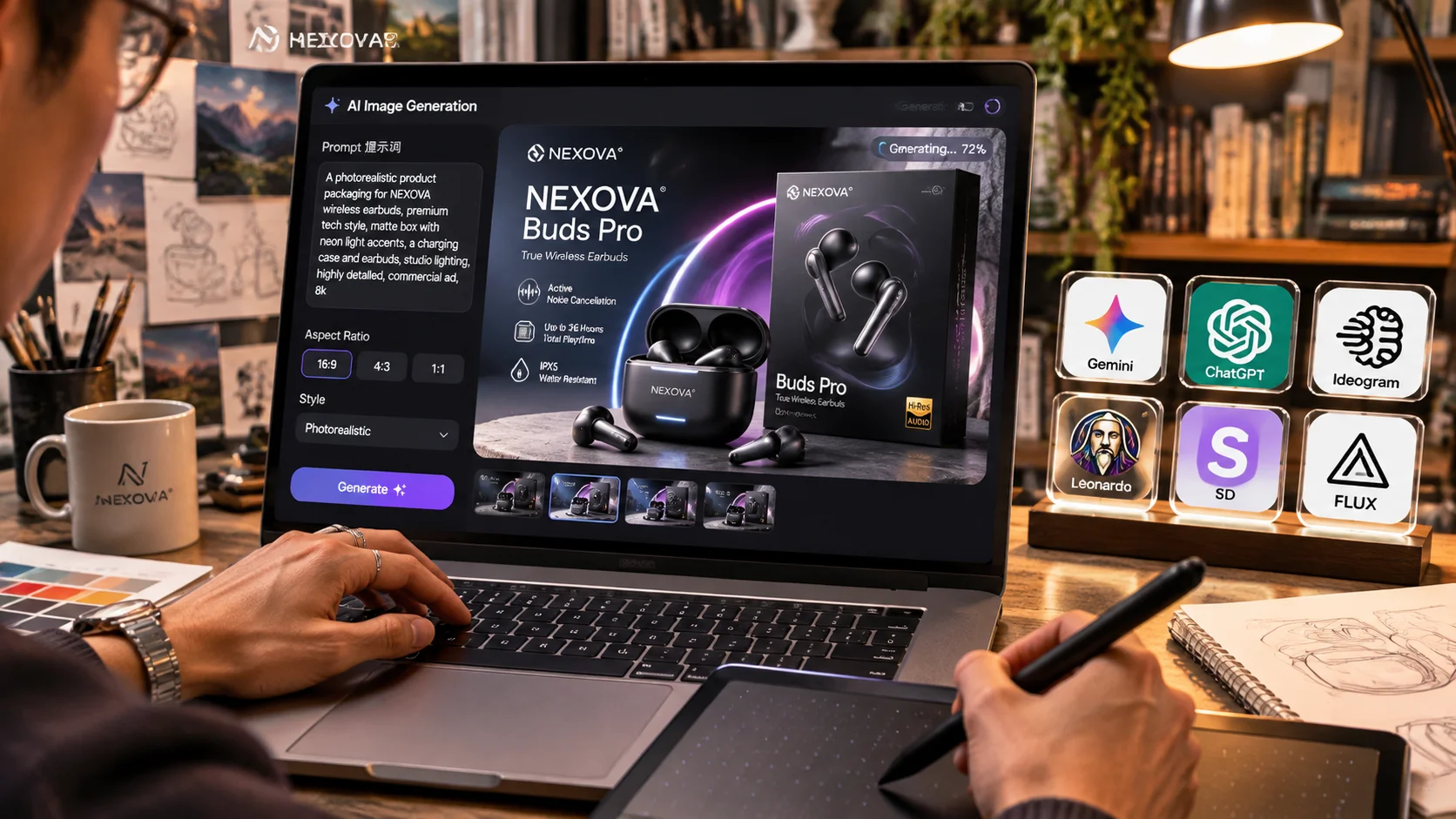
Most “best free” lists treat image generators like toys. For product shots, ad concepts, or social assets that have to survive a client review, the free tier only matters if three things are true: the output is usable under a real brief, the commercial rights are clear enough to deliver, and the daily limits don’t collapse the moment you start iterating.
Here’s the practical ranking after checking current free allowances, model versions, and licensing as of early November 2026.
Quick decision table

Need | Best free option right now | Main commercial caveat |
|---|---|---|
Everyday volume + low friction | Google Gemini (Nano Banana 2 / 2.1) | 1K resolution + watermarks on free |
Conversational editing | ChatGPT Images 2.5 | Unpublished daily limit; treat as sketch tool |
Readable text in-image | Ideogram | Public by default; 30 credits/week |
Higher daily volume | Leonardo AI | Public images + Leonardo retains broad rights |
Full control, no platform cap | Local (FLUX 3 Klein preferred) | Setup cost in time and VRAM |
The tools that matter in real commercial use
Google Gemini (Nano Banana line)
Still the most practical free starting point for most commercial freelancers. Free accounts get image generation in the Gemini app, currently routed through Nano Banana 2, the lighter 2 Lite, or the October 2026 2.1 update depending on account state. Limits are compute-based and no longer published as a hard daily number. Free downloads are capped at 1K; higher resolutions and Pro redos require a paid Google AI plan. Every free image carries SynthID plus a visible watermark.
Good enough for early concept rounds, moodboards, and rapid direction testing. Not the tool you want when the client needs private, high-res, watermark-free finals or when you need consistent character reference across a series.
ChatGPT Images 2.5
Best when you already live in ChatGPT and need fast back-and-forth edits inside the same thread (“make the lighting warmer,” “crop tighter,” “swap the background color to brand hex”). Free tier access exists but the exact daily count is unpublished—OpenAI simply labels it “limited.” Community testing shows it varies with load.
The conversational workflow is the real advantage. Treat it as a sketch and iteration tool, not a high-volume production engine. Once you hit the limit, the reset timing is not always predictable, which makes it unreliable for deadline-driven batches.
Ideogram
Still the tool I reach for when the brief requires legible text inside the image—packaging mockups, posters, social graphics with type, or any job where text failure is expensive. Free accounts that sign in with Google, Apple, or Microsoft get 30 credits per week. Images are public by default. Commercial use is permitted on the free tier (with the usual restriction against using outputs to train competing models).
The quality gap on readable text remains noticeable compared with most free alternatives. The trade-off is volume and privacy: 30 credits is not a lot once you start iterating, and public status creates downstream problems for client work.
Leonardo AI
150 fast tokens per day, refreshed daily with no rollover. That usually translates to roughly 25–37 standard images depending on model and settings. Free outputs are public and Leonardo retains broad rights to use, reproduce, and distribute them, though you receive a non-exclusive commercial license.
Useful when you need more daily volume than Gemini or ChatGPT give you, especially for game assets, concept exploration, or rapid style testing. The rights situation is the weakest of the free options for client-facing deliverables—check the current terms before promising exclusivity.
Local options (FLUX 3 Klein preferred over SD 3.5)
Once the hardware and a frontend (ComfyUI is the practical standard in 2026) are set up, there is no platform limit and no forced public gallery. FLUX 3 Klein (5.6B open weights, released mid-October 2026) currently outperforms older open models on prompt adherence, photorealism, and multi-reference consistency while running on more modest VRAM than earlier FLUX.2 Dev variants. Stable Diffusion 3.5 remains viable if you already have a working LoRA or ControlNet stack.
The real cost is setup time and hardware, not credits. For commercial work this is usually the cleanest long-term free path once volume or privacy becomes the bottleneck.
What actually fails under a commercial brief
Public-by-default free tiers (Ideogram free, Leonardo free) create downstream problems the moment a client asks for private generations or exclusive rights.
Watermarks and resolution caps (Gemini free) force extra cleanup steps that erase the time you thought you saved.
Unpublished or load-dependent limits (ChatGPT free) make the tool unreliable for anything beyond a few exploratory rounds.
Token math that looks generous until you enable character consistency, higher quality, or multi-reference features (Leonardo).
Local setups that look free until you factor in the hours spent troubleshooting drivers, quantisation, and workflow stability.
Practical workflow that survives real jobs
Start concepts and direction testing in Gemini or ChatGPT for speed and conversational iteration.
Move any text-heavy or type-critical work to Ideogram early.
When volume, privacy, or final delivery quality becomes the constraint, switch to local FLUX 3 Klein (or a paid tier).
Never deliver free-tier public or watermarked images as final client assets without re-checking the exact license language that day.
Keep a short internal note of which free tool produced which round so you can explain the rights chain if the client asks later.
Free tools are useful for exploration and early rounds. They are rarely the right final delivery path for paid commercial work. The test is simple: run the specific model and plan against the actual brief before you promise a client anything. If it only looks good in a vacuum, it doesn’t make the cut.
For AI tool features, rules and availability, refer to their official sites.


Leave your thoughts here, too.